8279640145 7060016868
8279640145 7060016868

Students who have applied in IMU-CET ( Merchant Navy) Schedule on Saturday  24  May 2025 can Download their admit Card and send a copy of the Admit Card to Mob 8279640145 through the Whats app .


Download Result IMU-CET Exam 2025  : | CLICK HERE |

Sandeep Sir’s Doon Defence Academy, Dehradun (Uttarakhand)  is a leading merchant navy training institute offering merchant navy courses approved by DG shipping Govt. of India. Doon Defence Academy offer excellent coaching classes for Merchant Navy preparation. Join The Merchant Navy After Class 12th in India.

The Merchant Navy is a non-combatant commercial fleet, which deals with transporting cargo and occasionally, passengers, by sea. Its fleet is therefore composed of vessels (ships) such as passenger vessels (called liners/cruisers), cargo liners (also called bulk carriers) which carry cargo or oil tankers (called tankers), as well as other special types of vehicles. Their ships may belong to Indian or Foreign shipping companies. In fact, the Merchant Navy, is the backbone of International trade, carrying cargo across the globe.

Without the Merchant Navy much of the import-export business may grind to a halt. The ships today are highly sophisticated and technology intensive safety and efficiency of the ship are crucial and depends upon the professional ability, competence and dedication to duty, of a sea fairer, onboard the ship. Join Merchant Navy after Class 12th.


Download DDA Prospectus : | CLICK HERE | APPLY ONLINE IMU-CET COACHING : | CLICK HERE |

Naturally, a seafarer is expected to be highly professional for the safe and efficient operation of the ship. The training in India is of reasonably high standards and the Indian seafarers are one of the most sought after commodity in the shipping industry worldwide.

Today, there are several opportunities to fetch reasonably good salaries but the Merchant Navy may also offer equally rewarding salaries at a young age. Unfortunately, the knowledge on the subject of “What is Merchant Navy & How does one join it? Still remains the privilege of few people who already have their relatives and friends in this industry. With this in the background some useful information about a career in Merchant Navy is presented herein.

◘ 95% world trade is carried by sea.

◘ Raw material and finished goods are shipped by sea.

◘ Increased movement of goods due to globalization, hence growing the opportunities.

◘ Industry studies indicate that the demand for Indian officers worldwide is a strong and ever growing.

About Our Academy

Located at Opposite Green View Apartments, Near Touch Wood School, Sahastradhara Road, 9.2 km from Railway Station, 14 km from ISBT, 31 km from Airport, North India’s No.1 Coaching Institute “DOON DEFENCE ACADEMY”. It was founded by Sandeep Gupta, a Submariner of Indian Navy (Retd.) in 2005. Since then “DOON DEFENCE ACADEMY” is motivating, inspiring and guiding our young generation to join Merchant Navy. “DOON DEFENCE ACADEMY” is not a Manning Agency OR Maritime Training Institute who provide any certificate courses OR Agent of any Company / Institute. It is just a coaching institute who provides coaching for Written Test (online/offline) and interviews for various opening for Deck Cadets / TME / GME/ SEO etc. “DOON DEFENCE ACADEMY” is a genuine guide in North India for those, who wants to join Merchant Navy after. But apart from Written Test / Interview, “DOON DEFENCE ACADEMY” is also conducting classes for basic knowledge of shipping, which include Seamanship, Ship Constructions, various Duties, Fire Fighting and Fire Prevention, Basic Marine Engineering, Personal Safety and Social Responsibilities, Ship Organization, Basic Terms in Shipping, Types of Ship, Ship Safety and Security, Loyalty towards Ship, Respecting Senior and Do’s and Don’t, in Merchant Navy etc. under the supervision of Experienced Personality drawn from the shipping industries. “DOON DEFENCE ACADEMY” is basically trying to lay down the foundation for becoming a competent Seafarer. The bottom line is that, we at DOON DEFENCE ACADEMY are preparing students up to that level, where he can understand port and starboard instant of left and right and fore and aft instant of forward and backward.

Doon Defence AcademyDOON DEFENCE ACADEMY” has a very big infrastructure which include modern classrooms, library, other facilities like Spoken English classes, Motivation Movies, LCD Presentations etc. We are conducting Career Seminar, Counseling Session, Audio – Video Presentation at various schools/seminars for guiding and inspiring the students to join Merchant Navy throughout the year. Every year more than 1000 students are enrolling themselves to our coaching institute for various careers, options after 12th/ B.Sc./B.Tech Every year. With our able guidance so many students selected as a Deck Cadet / TME / GME/ SEO in various Shipping Companies/Institute like Tolani Maritime Institute, RL Institute of Nautical Science, TS Rehman, TS Chanakya, National Maritime University, MMTI, AP Mooler – MEARSK, Anglo – Eastern, Executive Shipping, Shipping Corporation of India (SCI), International Maritime Institute (IMI), Fleet Management, Wilhelmsen(Barber),Ship Management, Univan Shipping, HND Programme etc.

NOTE : Once again we want to bring it to the notice of every person who is concerned with “DOON DEFENCE ACADEMY” that “DOON DEFENCE ACADEMY” is not a lioisoning office/Manning Agency/ Recruitment cell/Maritime Training Institute who is giving any certificate / Agent of any company or Institute. It is a coaching Institute for written Test/Interview for various opening for Deck Cadets/ TME/ GME/SEO. Selection in Merchant Navy is absolutely free and fair. No money is required to be paid to anyone for selection. Please do not be mislead by someone. But as far as training is concerned the cost of training is to be borne by the candidate. For more information about this please contact the concerned authorities or log on www.dgshipping.com.

Careers in the Merchant Navy

As a Navigation Officer ( Deck Side )

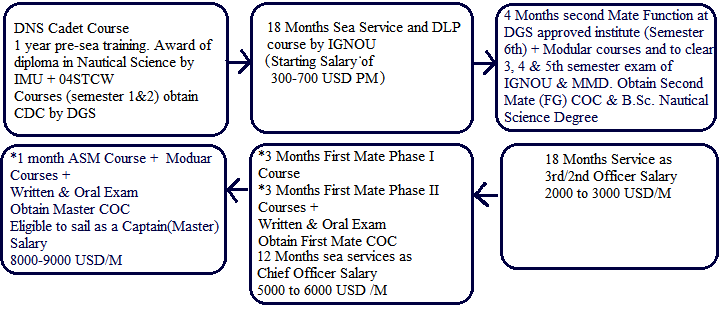
The officer from this branch looks after the ships navigation, loading/unloading of cargo and the general maintenance and administration of the ship. After completion of their training as a Deck Cadet, the officer joins in the rank of 3rd officer and subsequently promoted to the rank of the 2nd officer, chief officer and finally the Captain/ Master of the ship. All the promotions are subject to the individual passing his competency exams and his performance on-board the ship.

In addition to navigation duties normally, a 3rd officer looks after the life-saving appliances, the 2nd officer the passage planning and the navigation equipment, the chief officer look after the cargo work, and the Captain/ Master is the overall In-charge of the ship.

The subsequent promotions after acquiring a certificate of competency as second mate (F.G.), an officer is eligible to be appointed as a third or a second officer onboard a merchant ship and would draw a handsome salary for subsequent promotions, he has to render further sea service and progressively pass the higher examination appropriate for that rank viz. First mate (F.G.) and Master (F.G.). The certificate of competency as Master (F.G.) entitles the officers to become the captain of Merchant Navy ships.

As a Engineering Officer ( Inside Side )

A career at sea is very demanding as well as rewarding. It offers a high level of job satisfaction, a wide experience and challenging work environment. Experienced Marine Engineers are in great demand in all industries because of their ability to handle very large power plants, their resourcefulness, sense of responsibility and ability to work with their own hand with almost no external assistance. A Marine Engineer is a very valuable and responsible member of a ship’s team.

He has to operate and controls are engineering systems on-board his ship, and maintain them in good working condition. This gives him tremendous experience and confidence. However it must be understood that the life of a Marine Engineer is tough and not suited for the weak hearted. The ship’s engine room having the Main Engine, Boilers, Pumps, Hydraulic fuel systems, ship electrical generating plant and distribution.

Career Path for Engineer Officer

As a Graduate Mechanical Engineer

Graduate Mechanical Engineer (GME) – Career prospect: The department of Mechanical Engineering aims to provide the best mechanical engineering inputs to the marine engineers along with broad-based knowledge in practical applications. The job of Mechanical Engineers are contributing following major activities like ship building, workshop activities required in ship repairs like welding, riveting component machining, assembling & dismantling. The Mechanical Engineering department has core laboratories for heat transfer, applied mechanics, fluid machinery, refrigeration and air conditioning control and vibration analysis. The experiments are critically selected so as to cover the entire gamut of marine engineering principles. They have to work with Main Diesel Engines, Auxiliary Engines, Boiler, Purifiers, Pumps and other auxiliary machinery. They are also required to undergo extensive watch-keeping duties in plant operation and safety etc.

Eligibility:

Educational Qualification: Graduate in Mechanical Engineering / Naval Architecture from any Engineering College recognized by AICTE (Ministry of human Resource and Development). Candidate must be in possession of valid Engineering Degree/Provisional Certificate. And must have secured minimum 50% marks in English in 10th or 12th class.
Age: Not exceeding 25 years.
Medical: Medically fit as per the company/regulatory standards. Eyesight 2.0 & No color blindness.

Training Fee: The cost of Pre-sea training will include tuition fees, books, lodging, boarding, uniform etc and will be borne by the candidates. The training fees will be approximately Rs. 4,50,000/- (Rupees Four Lack  Fifty Thousand only) and payable directly to the training institute approved by DG Shipping. The fee for the training also depends on the company/Institute and subject to change for more information you can log on www.dgshipping.com.

Training: 01 Year pre-sea training at marine training institute approved by DG Shipping Govt. of India. This training provides a graduate Mechanical Engineer student a sure path to become a qualified Marine Engineer. On Selection, you will be nominated to undergo a 12 months residential per-sea orientation training on Marine Engineering at any chosen maritime training Institute in India. (Delhi, Mumbai, Chennai, Pune etc) At the pre-sea institute, apart from the academics, you will undergo training in workshops and simulators. On successful completion of the course, you will be awarded certificate. On completion of the pre-sea training of 12 months, you will join merchant Naval Vessel as Vth Engineer. You will go on the ship for 8 months and after returning back you can appear in Marine Engineers Officer class IV Exam, conducted by Director General of Shipping. On successful completion of the exam, you will be awarded class IV Certificate of competency by DG of shipping and can join back as the fourth Engineer. You can further appear in promotional exams and rise up to the rank of Chief Engineer who is equal to the rank of captain of the ship.

Career Path for Graduate Mechnical Engineer

Ships Electrical Officer

Ship’s Electrical Officer (SEO)

Career prospect: Every seagoing vessel must carry at least one Electrical Officer. That is why the department of Electrical is known for one man show (Bhatti Sahab) on board merchant naval vessels. Since SEO is an essential requirement there is a heavy demand in the international shipping industry. The work field of SEO is consisting of working on Main and emergency generator, High voltage generator and system, MSB & Power distribution – Procedures and Practices Power management system, Emergency Switchboard, Local Power Distribution, Emergency power & Shore supply, Other Electrical Machines A.C. Motor Starters, Protection Devices, Marine Electrical Cables, Marine Auxiliaries & Instrumentation Workshop, Electrical Equipment, Galley equipment, Laundry equipment, Practical on ship-board active boiler combustion control system and Full mission, Electromagnetism and AC theory, Basic Electrical concept and fundamental practices, DC Generators, Alternators, Electrical Motors Main and emergency generator, Electrical motors, Transformers, Automation and Instrumentation Familiarization with shipboard PMS. Special electrical practice for oil, gas, and chemical tankers Pneumatic & hydraulic systems etc.

Eligibility:

Educational Qualification:
Degree in Electrical Engineering from a recognized engineering college approved by AICTE (Ministry of human Resource and Development) with minimum 50% marks OR Diploma in Electrical Engineering with Ist class. And must have secured minimum 50% marks in English in 10th or 12th class.

Age:
Not exceeding 25 years.

Medical:
Medically fit as per the company / regulatory standards. Eyesight 2.5 & No colour blindness.

Training Fee:
The cost of Pre-sea training will include tuition fees, books, lodging, boarding, uniform etc. and will be borne by the candidates. The training fees will be approximately Rs. 2.50 Lakhs (Rupees Two Lakhs, Fifty Thousand Only) and payable directly to the training institute.

Training:
06 Months pre-sea training at marine training institute approved by DG Shipping Govt. of India. This training provides a Ship’s Electrical Officer aspirants a sure path to become a qualified Ship’s Electrical Officer. On Selection you will be nominated to under go a 06 months  residential pre-sea orientation training on Electrical Engineering at any chosen maritime training institute in India. (Delhi, Mumbai, Chennai, Pune etc.) At the pre-sea institute, apart from the academics, you will under go training in workshops and simulators. On successful completion of the course, you will be awarded certificate. On completion of the pre-sea training of 06 months, you will join Merchant Naval Vessel as Assistant Electrical Officer. After completing your first contact as an Assistant/Trainee Electrical Officer you can sail as an Electrical Officer on your second contract onwards. 

Career Path for Deck Officer

MERCHANT NAVY COACHING IN DEHRADUN

Eligibility Criteria

Deck Cadet (DGS+ IMU Scheme)-Leading to B.Sc. Nautical Science

Educational Qualification: Pass/appearing in 10+2 examination from a recognized Board/ University with Physics, Chemistry and Maths (PCM), with not less than 60% marks in PCM.

OR

with Physics as an individual subject in one of the years of B.Sc. in PCM or Electronics with an average of not less than 50% marks from a UGC/DEC recognized university.

OR

B.E./ B.Tech. Degree from college recognized by AICTE

AND

Should have passed with not less than 50% marks in English as a separate subject at either 10th or 12th standard.

Age: Not more than 25 years.

Medical: Eyesight should be 6/6 with no color blindness.

B.S. Nautical Technology

Educational Qualification: Pass/ appearing in 10+2 examination from a recognized Board/ University with Physics, Chemistry and Maths (PCM), with not less than 60% marks in PCM.

AND

Should have passed with not less than 50% marks in English as a separate subject at either 10th or 12th standard.

Age: Not more than 25 years.

Medical: Eyesight should be 6/6 with no color blindness.

04 Year Marine Engineering (TME)

Educational Qualification: Pass/ appearing in 10+2 examination from a recognized Board/ University with Physics, Chemistry and Maths (PCM), with not less than 60% marks in PCM.

AND

Should have passed with not less than 50% marks in English as a separate subject at either 10th or 12th standard.

Age: Not more than 25 years.

Medical: Use of corrective lenses permitted but the maximum permissible limits at entry are +_ 2.5 with no colour blindness.
NOTE : However DG Shipping have made guide line for different entry but some shipping companies/ Institute have their own criteria for their intake. It is our advise any person who wishes to join merchant navy should check his eyesight and color blindness test get done from some specialist doctor before applying. For more information, you can contact the concerned authority or log on to www.dgshipping.com.

Fee for Merchant Navy’s Different Courses

Fee for Deck Cadet (DG+IMU scheme) between Rs. 4 Lacks to 6.50 Lacks as per training institute, for B.S. Nautical Technology, between 11 lacks to 13 Lacks as per institute, for 04 year Marine Engineering (TME), between 12 lacks to 14 Lacks, for Graduate Mechanical Engineering (GME), between 3 Lacks to 4.5 Lacks. This is a compulsory residential program, so the fee is inclusive of Boarding/ Lodging, Tuition fee, Books, Uniforms, CDC etc. For the STCW courses which includes basic/ advanced modular courses, Simulator based courses, Competency courses, Re validation courses and value added courses are differ from institute to institute or company to company.

Note: The fee given above is only for information and subject to change as per Institute/ Company. However the amount is almost same for different courses but for more information you can contact the concerned authority or log on to www.dgshipping.com.

Engine Department Ranks

Chief Engineer

The Chief Engineer is head of the engine department and responsible for all machinery onboard including main engine, generators and technical systems.

Key Responsibilities:
* Machinery maintenance
* Engine department management
* Fuel consumption monitoring
* Technical safety compliance

Second Engineer

The Second Engineer manages daily engine room operations and maintenance schedules.

Key Responsibilities:
* Planned maintenance system
* Engine room supervision
* Spare parts management

Third Engineer

The Third Engineer usually handles boilers, fuel systems and auxiliary machinery.

Key Responsibilities:
* Boiler operation
* Fuel system management
* Machinery monitoring

Fourth Engineer

Junior engineer responsible for compressors, purifiers and support machinery.

Key Responsibilities:
* Auxiliary machinery checks
* Engine watchkeeping
* Maintenance assistance

Engine Cadet / Trainee Marine Engineer

A trainee engineer learning engine room operations and machinery systems.

Key Responsibilities:
* Assisting engineers
* Learning machinery operations
* Training record completion

Types of Commercial Ships in Merchant Navy

Commercial ships are various kinds of ships that transport cargo and passengers to different destinations. Commercial ships come in a range of sizes and shapes, to enable them to complete their intended purpose or duty. From freight liner ships to oil tankers, these ships are all designed to serve different purposes.

Different types of commercial ships can be classified in three ways: cargo capacity, weight, and size. The number of canal locks a ship may pass through is limited by its maximum dimensions, such as length and beam (beam); water depth (draught) is a constraint for canals, shallow straits, and ports; and height is a restriction for going under bridges. Ships are often custom-built for the operation, including cranes and other loading and unloading equipment, and come in a wide range of sizes.

These types of commercial ships are further classified into two categories based on the services they give to the industry: liners and tramp services.

CRUDE OIL TANKER :

Crude Oil Tankers transport a vast amount of crude oil from the extraction site to refineries, where it is further processed. Generally, a Crude Oil Tanker carries one cargo grade at a time. Crude oil is categorized into different varieties (crude grades). A crude oil ship normally transports just one cargo grade at a time. These tankers are substantially bigger than all the other types of oil vessels, ranging in size from 50,000 to over 500,000 tonnes deadweight, and hence they frequently load and unload at offshore buoys and terminals. An extensive global fleet of Crude Oil Tankers forms the backbone of the global economy.

SHUTTLE TANKER :

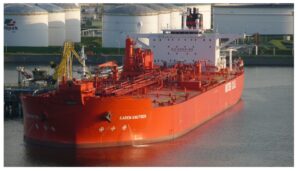
A Shuttle Tanker is a type of ship that delivers oil from offshore oil fields to land-based refineries, and it is widely used as a substitute for pipelines. It comes equipped with dynamic positioning to keep its location about the field, off-loading system of pipelines, and several safety measures to ensure that crude oil is handled safely. Shuttle Oil Tankers have also proven to be much safer than traditional crude oil tankers. Operators choose them because they are more flexible than pipelines that are attached to a single receiving point. Additionally, they possess the option to segregate the oil, unlike pipelines which need the entire network to be shut down. Shuttle tankers are relatively easy to maintain.

PRODUCT CARREIR :

Product tankers are smaller tankers with a capacity of up to 35,000 tonnes that are usually built to carry chemical cargoes, necessitating special design and equipment such as stainless steel cargo tanks, corrugated bulkheads, deep well pumps, and more complex piping systems. Product tankers transport refined oil (of various grades) to a location near the final market. Epoxy is used to coat the tanks, which protects the cargo while also making the tank easier to clean. Among the products carried are petroleum, jet fuel, diesel, asphalt, lubricating oil, and tar. Smaller tankers are also used to transport non-petroleum bulk liquids like molasses and palm oil.

CHEMICAL  TANKER :

The deadweight of chemical tankers ranges from 5,000 to 40,000 tonnes, and they frequently incorporate specialized cargo systems, tailored to transport a variety of liquid chemicals. Chemical tankers are built to maintain the uniformity of the chemicals they transport. Coatings of particular compounds sprayed on these tanker ships influence the type of payload that may be transported. To guarantee that the cargo retains its purity when placed into a multi-purpose tank, these systems may also contain heating or cooling apparatus, as well as modern cleaning systems.


LIQUIFIED GAS CARRIER :

Gas tankers are tankers that are specifically intended to transport various types of gases in bulk. These tankers are more technologically advanced than any other form of vessel, including bulkers, containers, and other types of tankers. Gas carriers can be divided into five groups based on the type of cargo transported and the conveyance situation. The distribution of these alternative energy sources to clients all over the globe helps to meet the worldwide market demand for energy and therefore contributes to the global energy supply chain. Cargo tanks are normally spherical for robustness, since they are used to transport Liquefied Petroleum Gas (LPG) or Liquefied Natural Gas (LNG) under pressure. IMO’s International Code for building and outfitting of ships carrying liquefied gases in bulk, specifies design and construction standards to ensure the ships’ safety.

REEFER SHIP :

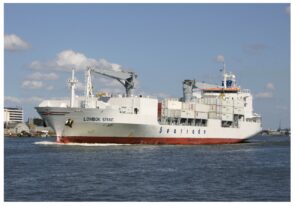
Refrigerated goods and perishable commodities that require particular climatic conditions, such as fruit or meat, are transported in “Reefer Vessels.” A reefer ship has specially insulated holds, into which cold air is piped at the correct temperature for the cargo.
Most traditional reefer boats have now been replaced by the use of chilled containers carried on board Container Ships. Reefer ships have different construction, power generating, and electrical distribution systems than regular cargo ships.


BULK CARRIER :

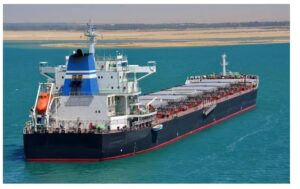
Bulk carriers carry unpackaged dry goods having a high weight-to-cost ratio, such as coal, grain, and ore. A bulk carrier has no walls, yet the middle deck is installed to keep the cargo from being pressed. To keep the cargo from tilting to one side, it contains a topside tank and a hopper tank. These ships are separated into multiple different holds, each of which is protected by a hatch. Cargo is loaded at the port using a conveyor and spouts, or a crane and grab. Some bulk carriers are outfitted (typically with a crane between each hatch) to allow goods to be loaded and unloaded at ports, without the need for shore equipment. A Vast fleet of Bulk Carrier acts as an important indicator of global trade.

BREAK-BULK CARRIER :

Break-Bulk Carriers are used for transporting bulk cargo without putting the cargo into shipping containers. These ships may use other storage mediums like pallets, etc. Although specific handling facilities for such things may exist, the majority of loading and unloading is done with cranes, straps, or slings. Whereas, when hauling loose and irregular cargo, the crew and port stevedores pack the cargo. They do not require the availability of a specific berth or terminal. They can be further classified into Single Decker, Tween Decker, and Box Holds, to name a few. General cargo boats are still in use across the world, despite being mostly superseded by the revolution brought down by containerization. The ‘Freight Ton’ or ‘Revenue Ton’ method is used for computing freight rates for breakbulk shipments.

RO-RO VESSELS :

RO-RO (roll-on/roll-off) ships are cargo ships that transport wheeled products such as cars, trucks, semi-trailer trucks, buses, trailers, and railway carriages. These ships allow freight to be driven right on and off, making it a conducive mode of transportation. Their classifications include PCC (Pure Car Carriers) and PCTC (Pure Car & Truck Carriers), all of which fulfil the same purpose. In contrast to shipping cargo, which is determined by multiplying the cargo length in meters by the number of decks and lanes, Ro-Ro freight is measured in lane meters.

OFFSHORE VESSELS :

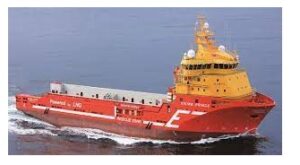
Offshore Vessels are support ships, that are primarily designed to serve the offshore oil and gas sector, by performing certain specialized tasks on the high seas. These are used for several tasks, including oil exploration and drilling, as well as transporting supplies to excavation and construction units on the high seas. These may also assist in the transit of crewing people to and from the high seas’ operational venues as required. Offshore operators may also deploy lodging, construction, service, production, or storage units in addition to drilling units. Offshore boats are among the most technologically advanced vessels, and are required to carry out precise tasks in extreme circumstances while also assuring the safety of all individuals involved.

CRUISE SHIPS :

Cruise Ships are designed to provide customers with housing and entertainment, while specifically focussing on onboard amenities and comforts. Cruises are designed to transfer guests between ports according to a holiday itinerary, rather than from one location to another. The largest cruise ship can accommodate over 6,500 guests alongwith 2,000 crew members, making the cruise business a major source of employment generation in the Marine Industry.

The cruise business is quickly expanding all over the world. Since 1990, the total number of passengers has increased by 7.5 percent each year, from 3.7 million to 32 million, which means it has grown at double the rate of the worldwide tourism business.

TUG SHIPS :

Tugs are small but strong ships, that aid in navigating bigger ships. Harbour tugs are used in ports all around the globe to help in berthing, unberthing, and moving huge or difficult-to-move boats, as well as transporting barges, floating cranes, and personnel within port boundaries. As deep-sea rescue and salvage tugs, larger tugs are stationed at strategic locations. Tugs are also employed to transfer large structures from one port to another, such as offshore platforms and floating storage units.

ADVANTAGES OF MERCHANT NAVY CAREER

An Early Financial Independence :

Young seafarers are paid quite well in US dollars which are comparatively higher than their fellows onshore in other industries. Most shipping companies offer excellent packages, incentives, and benefits right from the start of your career that is comparable to or superior to any other industry in the world. The cost of joining, travel and flights at the time of sign-on and sign-off is paid by the company itself, apart from the high income which you get in Merchant Navy. Hence young seafarers get early financial independence in Merchant Navy.

Long Vacations  :

Since the profession of the Merchant Navy requires long working hours, the vacations offered to the professionals of the Merchant Navy are equally compensatory. Long vacations in Merchant Navy is definitely a privilege for seafarers. They themselves decide their availability for the next contract. This allows seafarers to enjoy the best of both worlds: land and water. A vacation of more than 3-4 months is definitely long enough to relax and indulge in all your passions, isn’t it? The vacation a sailor gets is in its purest form, there is absolutely no job stress while a sailor is at home and you can fully enjoy time with his family or pursue his/her passion. The people with enthusiasm to work hard and a will to live well should look for a career in the Merchantile Marine. It would be satisfying without the person experiencing any remorse in their chosen profession.

Enhanced Discipline and Professionalism :

A profession like a Merchant Navy gets you to work with different nationalities onboard which enhances the sense of adaptability and professionalism in seafarers. This also helps the individual understand and function better as a team player while learning the importance of different cultures and traditions. Merchant mariners must have good communication skills, along with the observance and maintenance of a high level of discipline. While working onboard, a person develops professionally and personally. This professionalism goes hand in hand with great responsibility towards the ship and its crew.

Tax Free Income :

A sailor’s income is taxed on the basis of his state of residence.

1. Resident Seafarers Income Tax:

The salary of resident seafarers or Merchant Marine personnel are taxed under the Income Tax Act of India. There are no income tax exemptions for seafarers.

2. Non-resident seafarers income tax (NRI status):

If a ship’s crew member works outside India for 183 days or more during the tax year according to his CDC (Continuous Discharge Certificate) or passport, his residency status will change to a non-resident sailor. The foreign salary of a non-resident seafarer/Merchant Marine personnel is not taxable in India. Hence Indian seafarers can have a tax-free income in Merchant Navy.

Adventure and Travel Opportunities :

This job is very adventurous since you can travel to different parts of the world. You could travel to almost any corner of the world without having to pay money out of your pocket. Other routine jobs in different sectors require people to work hard with very little time to roam freely around the world.

People who like nine to five jobs shouldn’t join the Merchant Navy. Commercial mariners can spend days exploring and seeing magnificent ocean views that soothing like none other. People spend hundreds of thousands of rupees on cruises to travel and you would do it for free because of your work profile.

Uniform and Respect :

It takes years of discipline, hard work, dedication, and work ethics for a maritime professional to become worthy of wearing the prestigious Merchant Navy uniform. These stylish uniforms not only fascinate the industry, but also those who have no idea what defines these maritime professionals. For some, the uniform is not just two pieces of clothing, but an experience, an achievement, and an attachment to an industry that made them what they are today. It is true that many young people dream of naval uniforms. However, you have to work hard to earn this privilege. Thus a uniformed job like the merchant navy helps you earn pride and dignity.

Temporary Seniors and Colleagues :

In a profession like Merchant Navy, where you work on a contractual basis, you work with different seniors in every contract. For deck crew, their captain would not be their permanent boss. Similarly, for the engine crew, their chief engineer would change in every contract or mid-sail. Here, in Merchant Navy you just have to bear a bad boss for a contract, chances are you won’t have to work under the same seniors again. On the other hand, if you are sailing with a good Chief Engineer or a Captain, unfortunately, he will also change in a few months.
The motto of Doon Defence Academy’s is to serve the Country First.

Every year more than 5000 students enroll themselves for the different career prospective and DDA has given more than 14000+ selections in last 20 years.